
THE COUNCIL MARK
A secondary Field Scrawl mark for older debt, missing voices, and inherited authority.
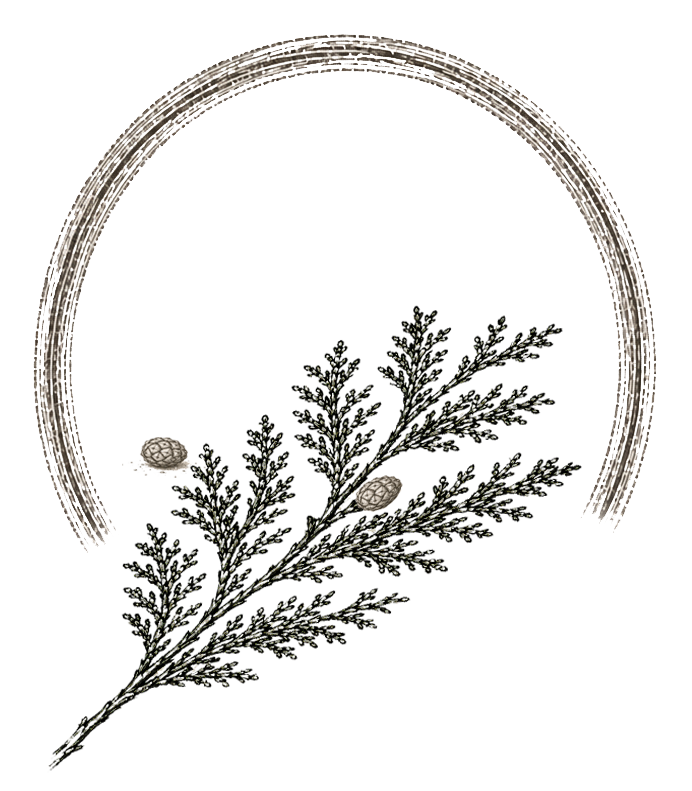
This page belongs to the LEDGER record because it defines a secondary mark: a sign used when the work encounters older debt, missing voices, inherited authority, or a council that cannot honestly be drawn as whole.
The cedar in this mark is not proof of a settled history. It is material under review: living bough, wet ground, rot resistance, canoe possibility, and the obligation to leave uncertainty visible when the evidence does not close the circle.
A Bough Across the Breach
The mark began with a question from 1757.
At the commencement of a meeting with the governor of South Carolina, the Cherokee leader Little Carpenter looked around the colonial council and hesitated. The room was male. The business was official. The authority appeared settled.
Burrows describes Little Carpenter as pressing the point:
Where are your women?
That question stayed with me.
Not because it belongs to me. It does not. Not because I can claim the Cherokee council world behind it. I cannot. But because the question exposes something broken in the room. The council claimed authority, but it was incomplete before a word of business had even begun.
The absence was already evidence.
James Adair’s response gives the breach its shape. Raised within a paternalistic Scots-Irish world, he saw Cherokee women’s public influence not as civic strength but as disorder — “petticoat government.” Little Carpenter’s question exposed the absence in the colonial room. Adair’s reaction exposed the inherited mindset that made that absence seem natural.
That mindset is the inherited seat: the place of authority a man is trained to occupy before he has even questioned who is missing from the room.
That is the seat I am talking about.
Not ancestry as blood alone, but the old posture of authority: male, colonial, confident, and trained to mistake exclusion for order.
The circle in this mark is left open for that reason. A complete ring would lie. It would make the council appear whole. It would turn absence into design and allow the breach to disappear into symmetry.
So the circle remains unfinished.
The opening is not a mistake. It is the point.
It marks a council that cannot call itself complete while voices are missing. It marks inherited authority that should not be accepted simply because it was handed down. It marks the old room: colonial, male, confident, organized around possession, procedure, appetite, and the assumption that it had the right to speak for more than it could honestly hear.
I know what I look like in the present tense of this country. I know the seat that appearance can seem to offer. Old white man. Beard gone gray. Male. Catholic by inheritance. Irish by family line, but folded now into the broader category of whiteness this country built and weaponized.
That does not make heritage simple. It does not make identity clean. It does not let me pretend I stand outside the ledger.
But it also does not require me to sit in the inherited seat as though its authority were natural.
That is part of the mark too.
The cedar bough is laid across the opening as witness.
Not decoration.
Not repair.
Not absolution.
It does not close the circle. It does not heal the breach. It does not make the council whole. It is placed there so the breach remains visible.
Cedar entered this mark because I had already been thinking about wet ground, old timber use, the dugouts, the Behemoth question, and old wetland timber use.
I went looking for cedar with those questions in mind. The bough used in this mark came from that walk — brought back, handled, photographed, and laid across the open circle as a field study. It is not ornament. It is witness material.
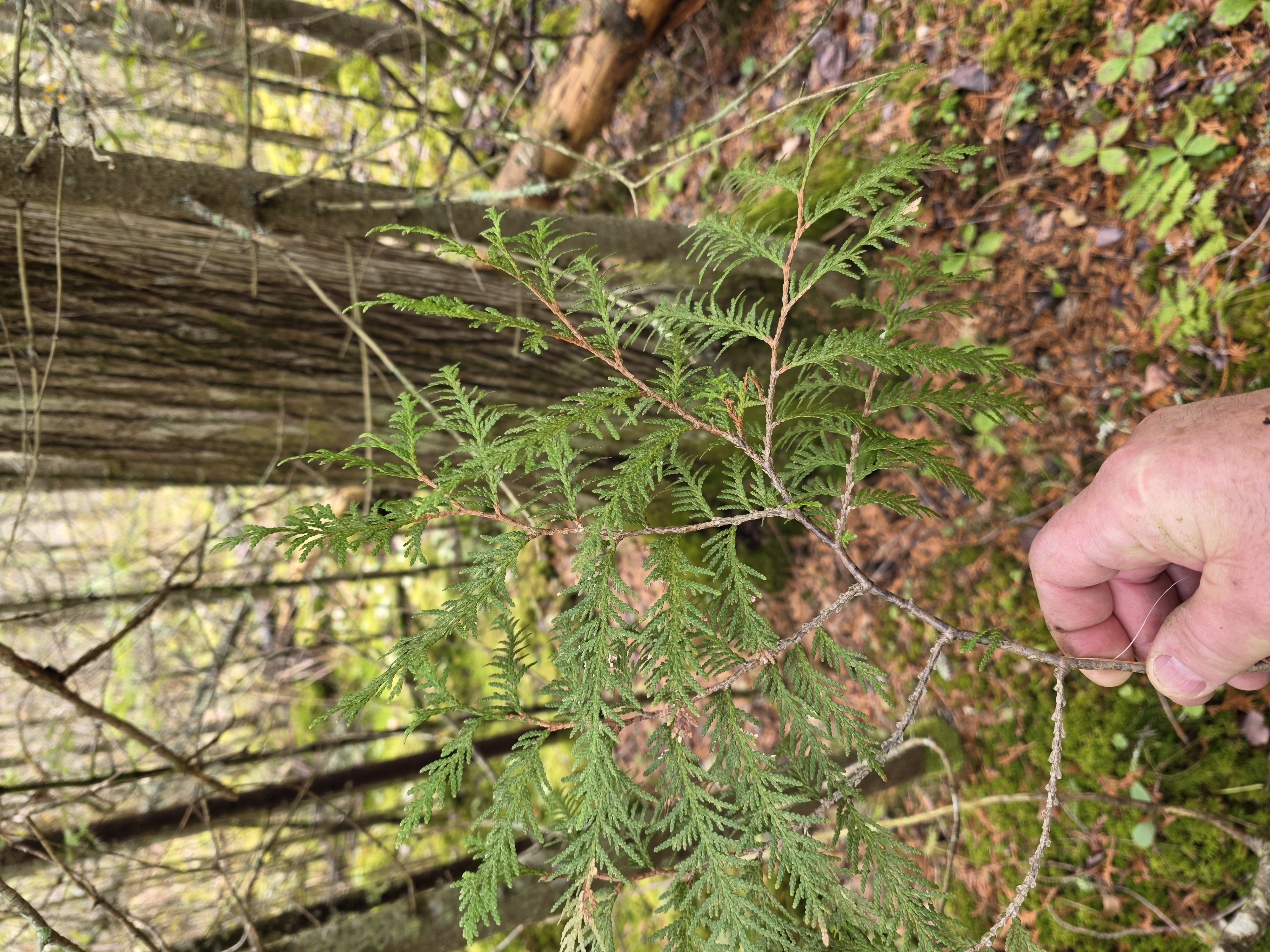
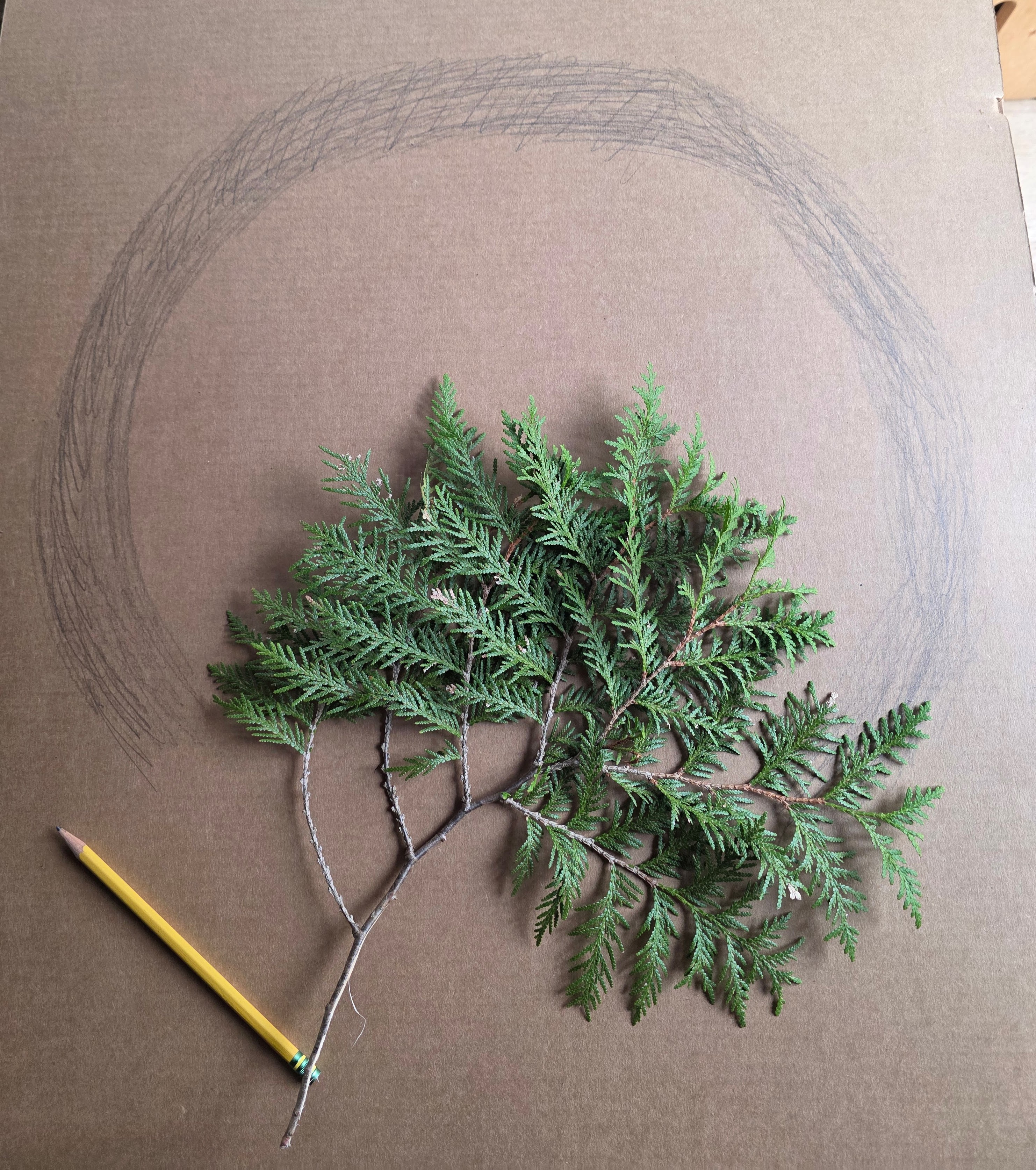
After the field study, the cedar bough was not discarded. It now hangs beside the drum at the back of the cedar lean-to — a kept witness from the walk, and a reminder that the mark began with handled material, not abstraction.
Cedar holds wet ground.
Cedar resists rot.
Cedar carries use, shelter, water, boats, memory.
Cedar belongs to the material questions now being asked of this place.
Another branch could have been laid across the breach. White pine, hemlock, spruce, balsam — each would have carried a different meaning. But cedar is the witness currently under audit here. Cedar is the material my attention had already been forced to handle.
So cedar is placed at the breach.
A small cone remains with the bough. Another has fallen into the open space.
The fallen cone is not redemption. It is not triumph. It is not the easy language of healing. The absence is not covered that quickly.
The cone means continuance.
A seed body in the unresolved center.
Future life, maybe.
Not a guarantee.
Not a settlement of debt.
Only the fact that something living has entered the unfinished place.
The center remains empty because some absences should not be filled too fast.
This mark is not the Field Scrawl logo. The primary mark remains what it is: quill, pen, record, witness. This is something else.
A secondary mark.
A council mark.
A ledger sign.
It belongs where the work turns toward older debt, missing voices, inherited authority, frontier appetite, land treated as resource instead of homeland, and the uneasy question of what a person does with a seat he refuses to occupy.
It also belongs under restraint. It should not appear everywhere. If used too often, it becomes decoration. Used sparingly, it keeps force.
The council is not complete.
The breach remains visible.
Cedar is laid across it as witness, refusal, and continuance.
Source note: Little Carpenter’s question and James Adair’s response are drawn from Lawrence Burrows, War on the Turtle’s Back, p. 37.