
WHAT I HAD NOT TAKEN THE TIME TO RECORD
One humid walk through the woods and five fungi already present
Date / Moment: August 6, 2026, late morning
Location: The Place / Lean-to path and surrounding woods
Type: Observation
The morning had been fairly clear but humid, with thunderstorms expected shortly. From the Upper Watch, patchy clouds moved across a mostly calm pond while a light breeze shifted between northwest and southwest.
I went down toward the lean-to to check the canoe.
I had left it near the place where I launch from shore and wanted to make sure it was still there and secure. It was. I carried my fishing rods into the lean-to, then took a slower route back through the woods to check some of the earlier plantings.
I have noticed mushrooms here before. As I move through the woods, I am constantly scanning the environment around me—the ground, understory, trees, water, tracks, plantings, wind damage, and whatever has changed since the last time through. Mushrooms have always been part of that field of attention.
What stood out that morning was how plentiful they seemed and how many different forms appeared along a relatively short route.
Once I stopped to photograph one, I continued stopping: a small red-orange cap, a tight cluster of yellow clubs, a larger branching coral fungus, a broad orange-brown polypore, and a red-patterned bolete with pores beneath its cap instead of gills.
I had never taken the observation much further.
This time, their abundance and variety were enough to make me begin a page.
The first five
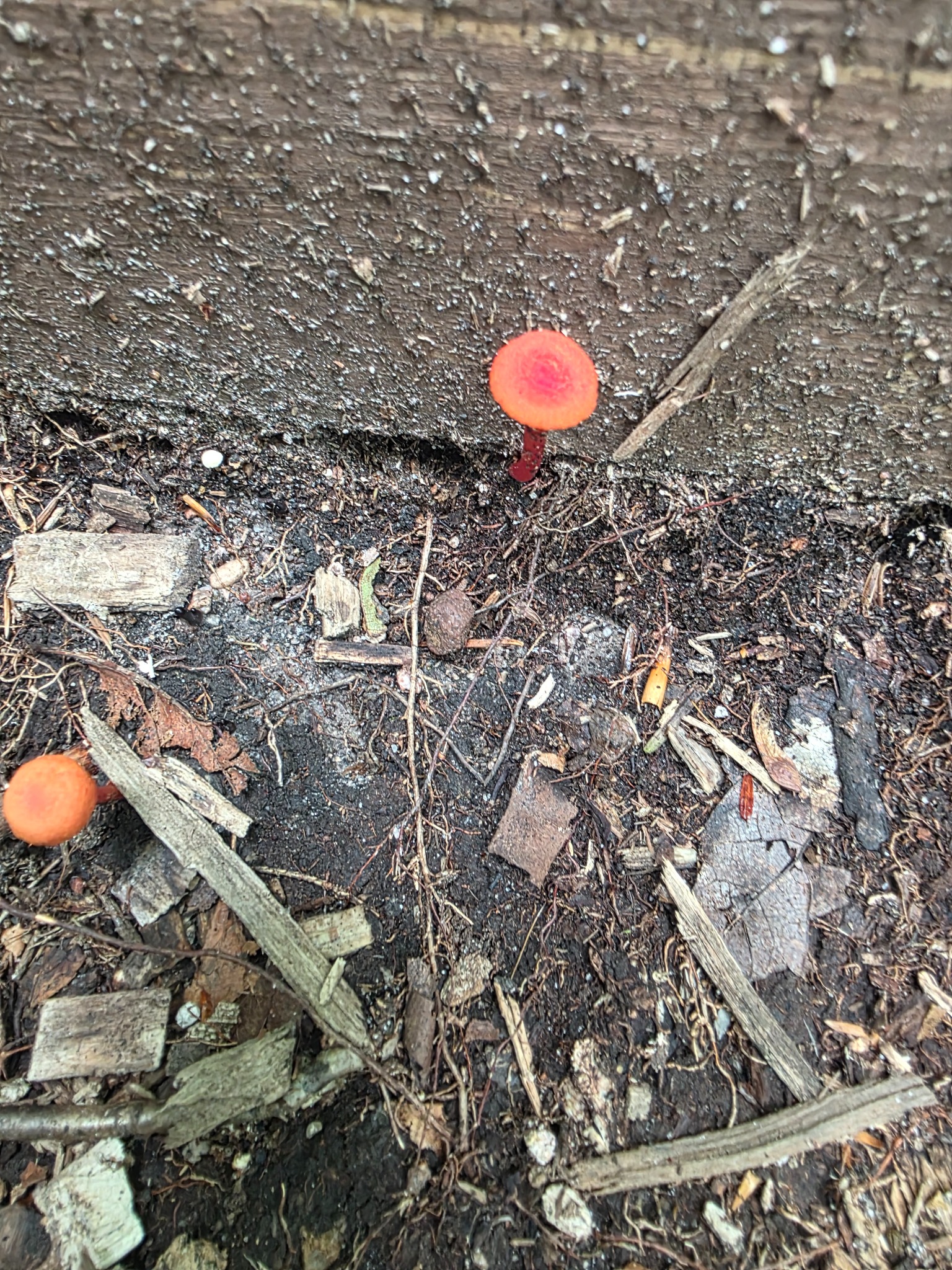
1. Red-orange waxcap-type mushroom
A small, intensely colored mushroom stood beside decaying wood and forest litter. Its red-orange cap and reddish stem suggest a waxcap or a closely related mushroom, although the underside was not photographed and the identification remains provisional.
Identification: Waxcap-type mushroom, possibly Hygrocybe
Certainty: Tentative
2. Yellow club fungus
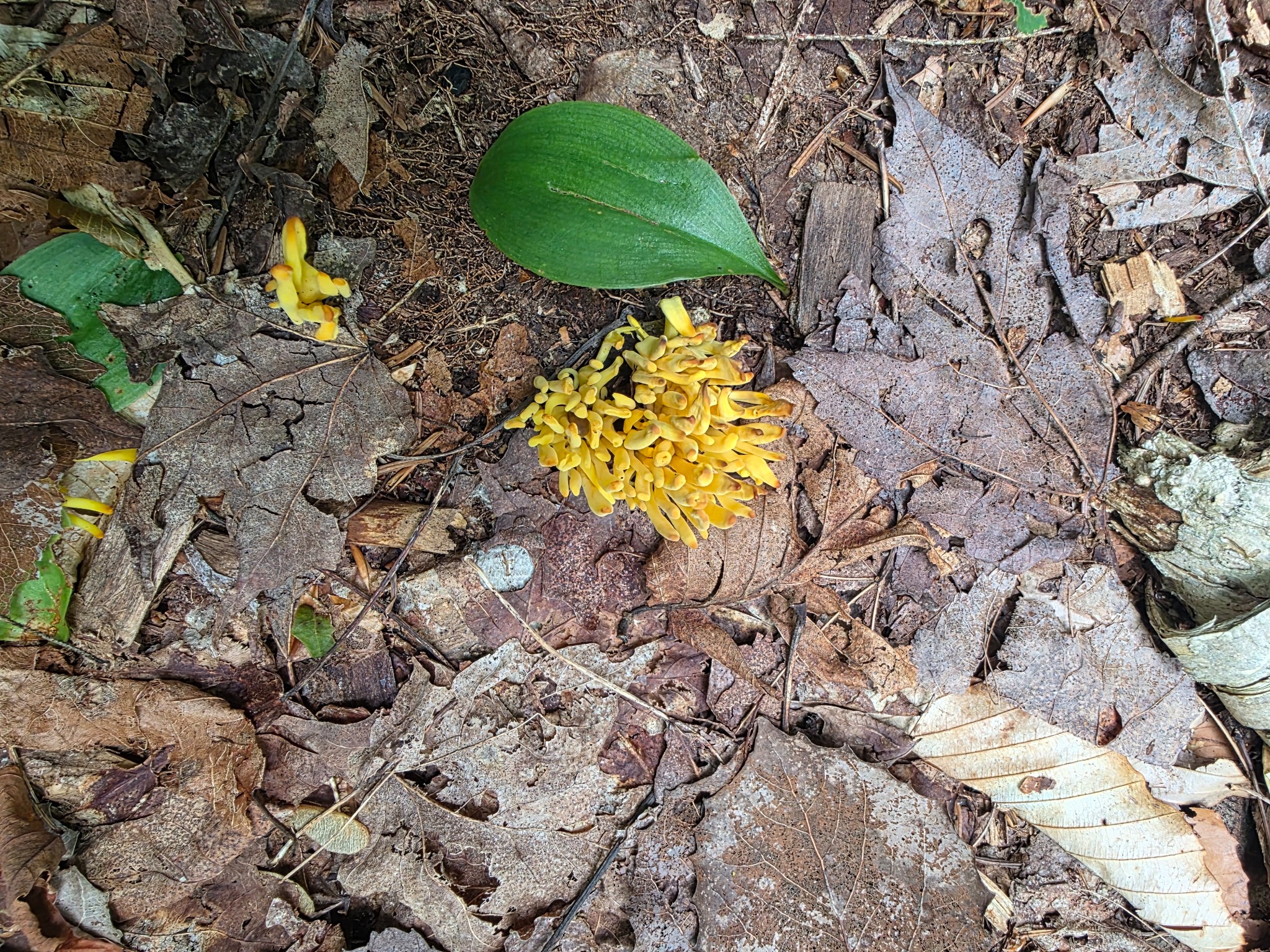
A dense cluster of smooth yellow clubs emerged through the leaf litter. Unlike the larger coral fungus found nearby, these forms were mostly unbranched.
Identification: Yellow club fungus, probably Clavulinopsis
Certainty: Moderate
3. Yellow coral fungus
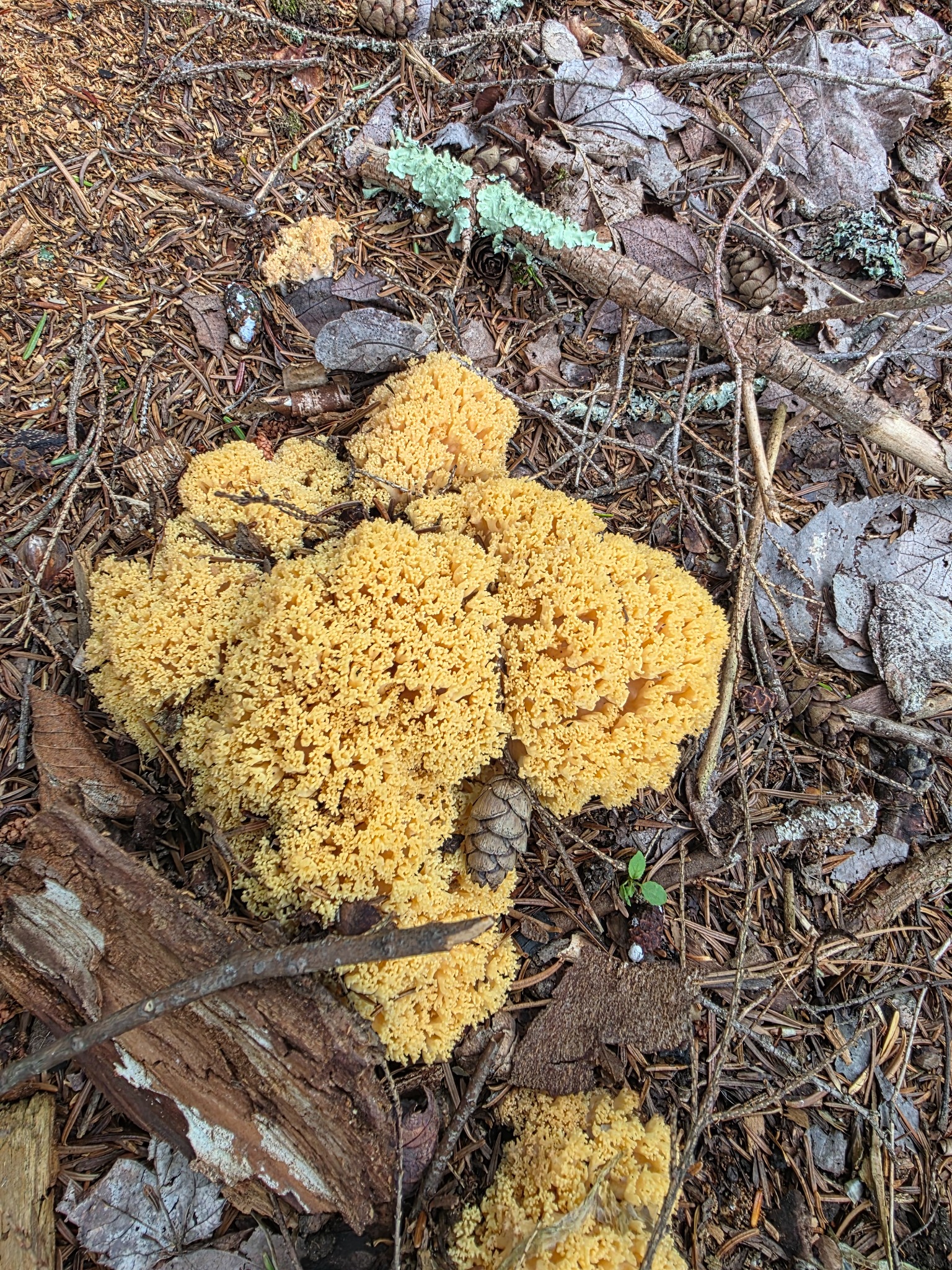
This fungus formed a broad, densely branching mass resembling a small yellow coral head. It appears to belong to Ramaria or a closely related group. Exact species identification would require more than the photograph provides.
Identification: Ramaria or related coral fungus
Certainty: High for the general group; low for species
4. Dyer’s polypore
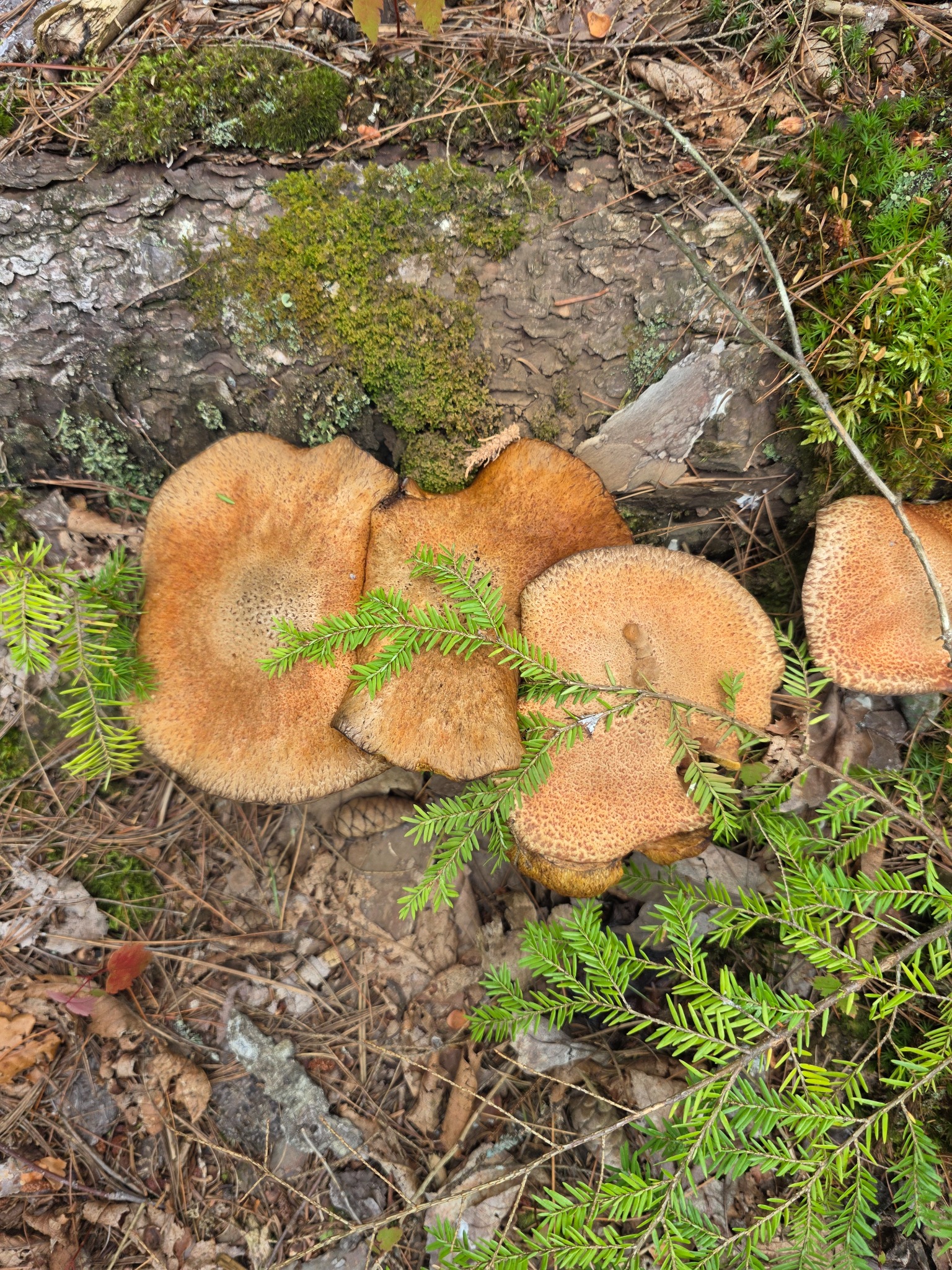
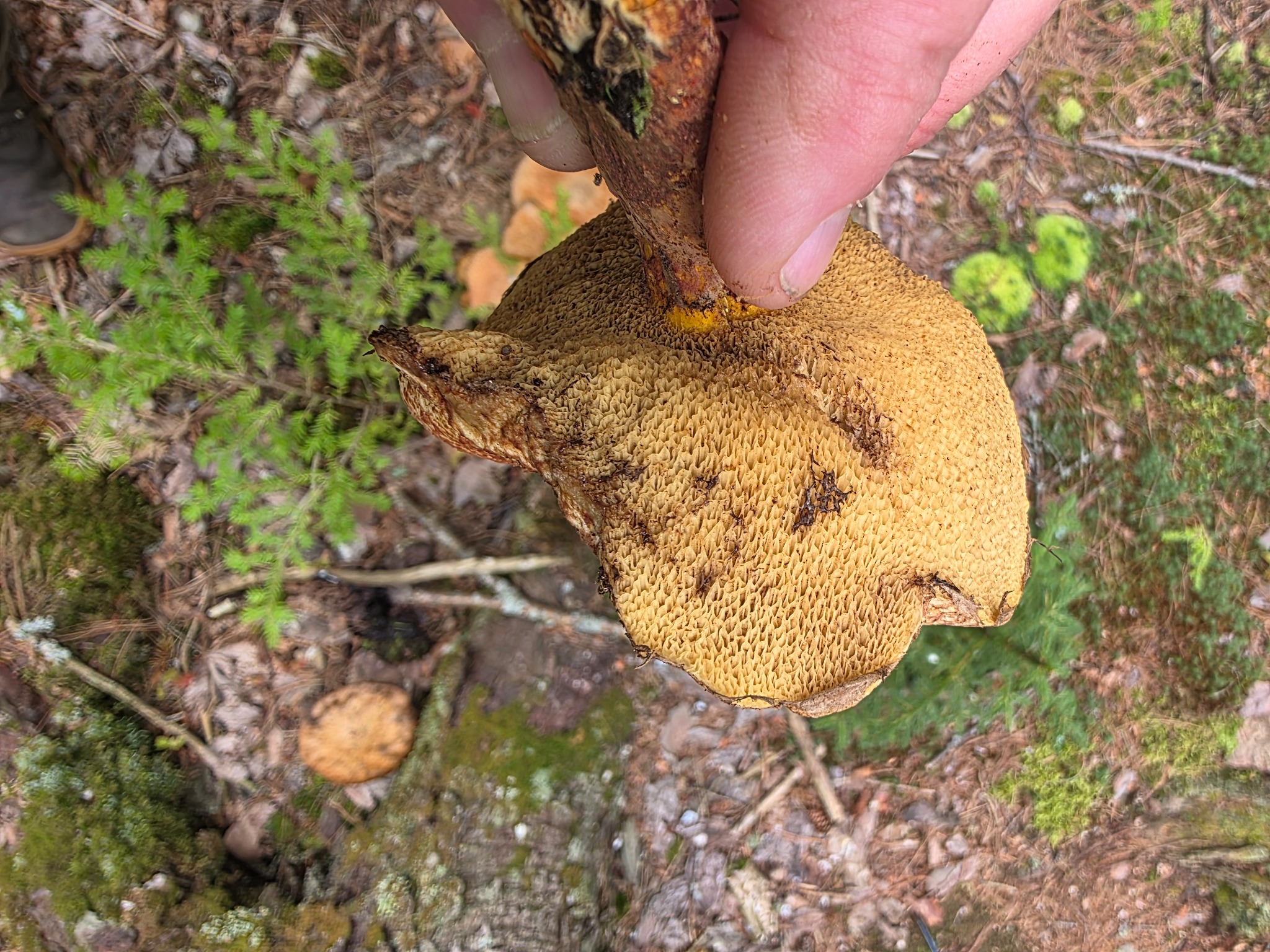
Several broad orange-brown caps grew together near conifer roots or buried wood. The undersides carried coarse, angular pores rather than gills.
The form is consistent with dyer’s polypore, Phaeolus schweinitzii, a fungus associated with the roots and lower trunks of conifers.
Identification: Probable dyer’s polypore
Certainty: Fairly high
5. Painted bolete
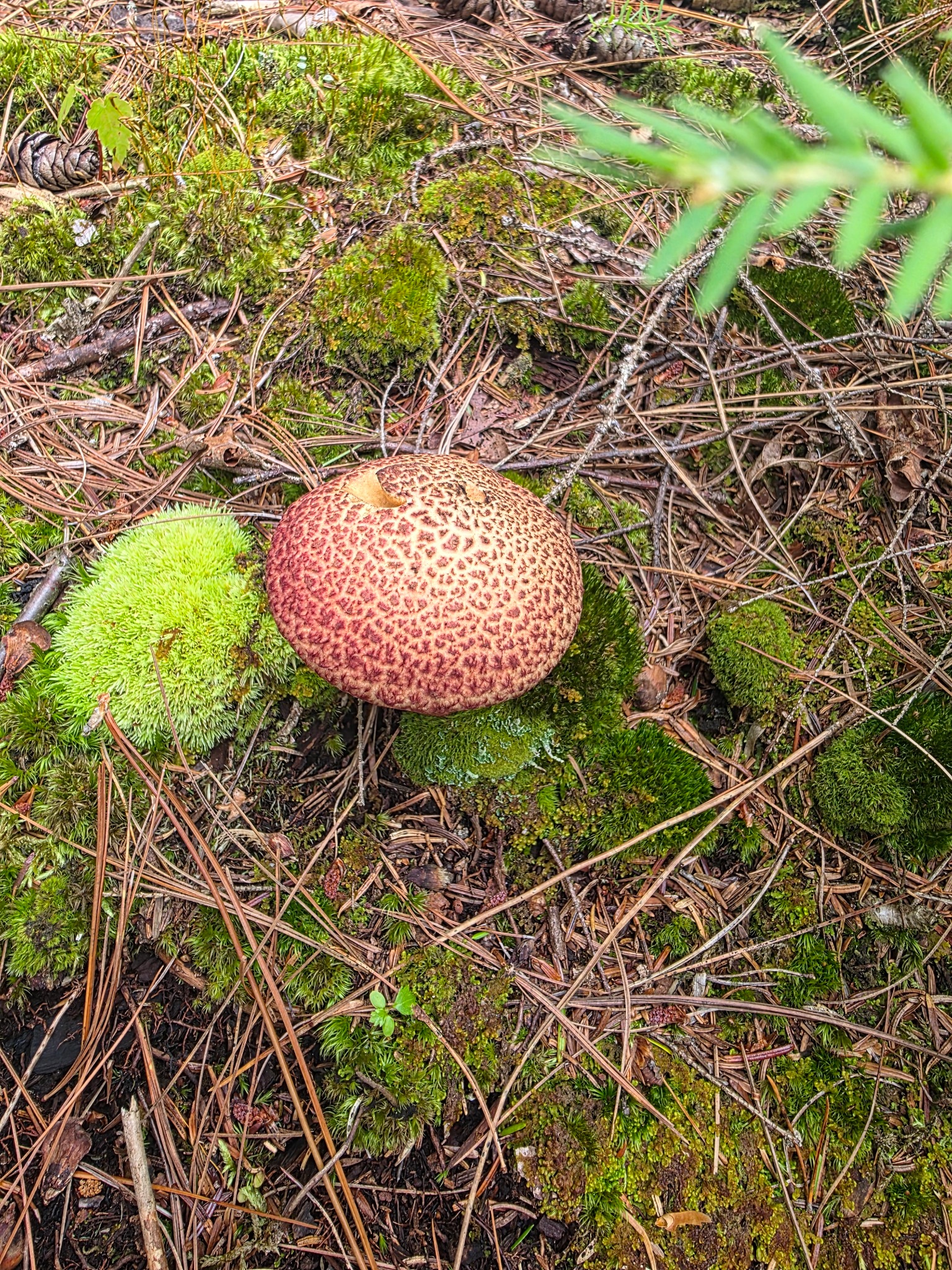
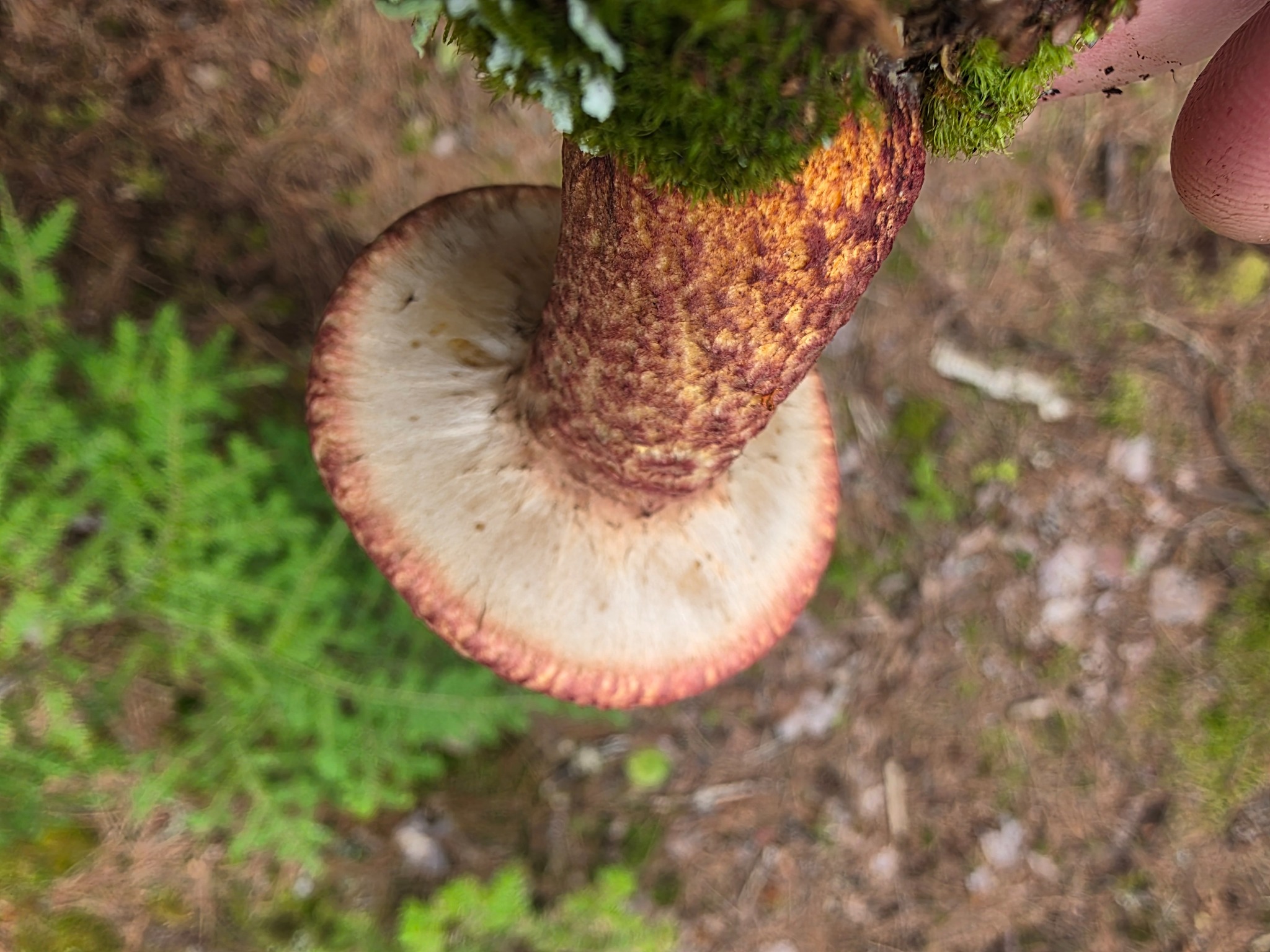
The final mushroom had a red, broken pattern across the cap, with pale yellow tissue showing between the scales. Its underside consisted of pores, and the stem carried the same red-and-yellow patterning.
Those features strongly match the painted bolete, Suillus spraguei, a species associated with eastern white pine.
Identification: Painted bolete
Certainty: High
What mushrooms had meant before
Growing up at Lake Nebo, the mushrooms that received our attention were generally the large shelf fungi that grew from trees.
Some became large enough to be removed and kept at camp. Their pale undersides were used almost like drawing boards. A name, image, or scene could be scratched into the surface, and the damaged tissue darkened to preserve the marks.
They were probably artist’s conks or a similar bracket fungus.
I remember the decorated mushrooms more clearly than I remember anyone identifying the fungus itself. The mushroom was useful because it could hold an image. Whatever it had been doing inside the tree was not part of the conversation.
My mother also warned us not to get too close to mushrooms because we might breathe their spores.
I do not know what she expected would happen if we did. Perhaps she had been given the same warning as a child. In any case, it helped establish mushrooms as something better left alone: not especially interesting, possibly unhealthy, and rarely worth examining closely.
That attitude apparently stayed with me.
Taking the time afterward
The mushrooms photographed that morning do not amount to a fungal survey of the property.
They were found during one walk through a small portion of the woods. Other species were almost certainly present beyond the route I followed, beneath the litter, inside decaying wood, attached to living roots, or waiting for different moisture and temperature conditions before producing visible fruiting bodies.
The difference was what happened afterward.
Usually, I would see one, register it as part of the woods, and continue with whatever had taken me outside. On this walk, they seemed plentiful enough—and varied enough—that I stopped repeatedly, photographed them, and later looked through the images rather than letting the observations end along the trail.
Back at the Upper Watch, I reviewed the photographs while waiting for the approaching thunderstorms. The space was now completely screened, leaving the pond, moving clouds, and uncertain breeze visible without the insects entering with them.
What began that morning was not my noticing mushrooms for the first time.
It was my deciding that what I had been seeing deserved a continuing record.