
THE BATTEN KILL HAS ZEBRA MUSSELS
Date / Moment: August 30, 2026
Fieldwork conducted: September 22, 2009
The Batten Kill survey was moving the way those surveys moved: upstream to downstream, station to station, waders on, gear in the truck, the day divided by bridges, access points, lunch, and the next reach of water.
There were twelve stations, or close to it. By the time we reached Shushan, we were about halfway through the day.
Chris F. was with me. He was new to Watershed Assessment Associates, though not new to field work. He had trained as a taxonomist and biologist, had worked out west, and had come back east. This may have been his first year in the field with me.
We stopped for lunch at the grocery store in Shushan, the one with the meat market and deli. Subs and chips.
Chips have a way of staying in the record.
We were still in waders near the river. The shoreline there had an exposed section of shale that ran from the bank down into the water. I remember Chris standing there with sunglasses on, casually looking down while we were talking or while the day paused in that way field days sometimes pause.
Then he bent over and picked something up by hand.
He said, “The Batten Kill has zebra mussels.”
That was the sentence.
He had lifted an adult zebra mussel from the shale. Once we saw it, we looked closer. There were more. We picked several from the same exposed shale and crevice area, preserved them, and finished the day.
The find did not stop the survey.
That belongs in the record too. Field work does not always make room for drama. Sometimes the thing that changes the record is bagged, labeled, and carried forward while the next station is still waiting.
Later, I placed the preserved mussels in a watch glass and photographed them against an inch ruler. I remember taking that picture. The original image is still in my files: several adult zebra mussels in the dish, the ruler below them, the field record made visible.
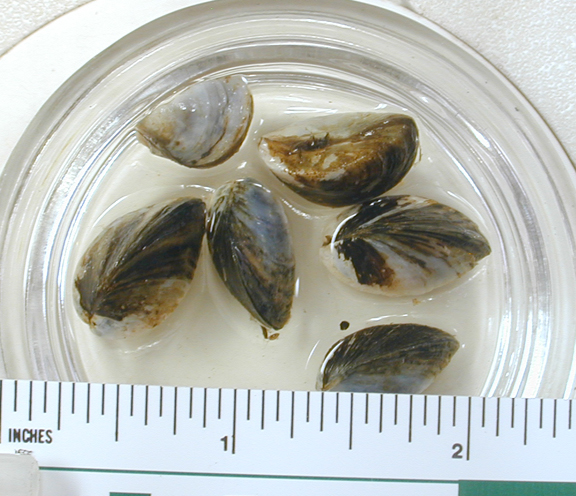
Those mussels came from that shale.
The official USGS Nonindigenous Aquatic Species record now holds the public version of that moment: Specimen ID 263724, adult zebra mussels collected from shale rock crevices at Shushan. The record notes several adults and points to the voucher photo. The photo credit belongs to J. Kelly Nolan, Watershed Assessment Associates, LLC.
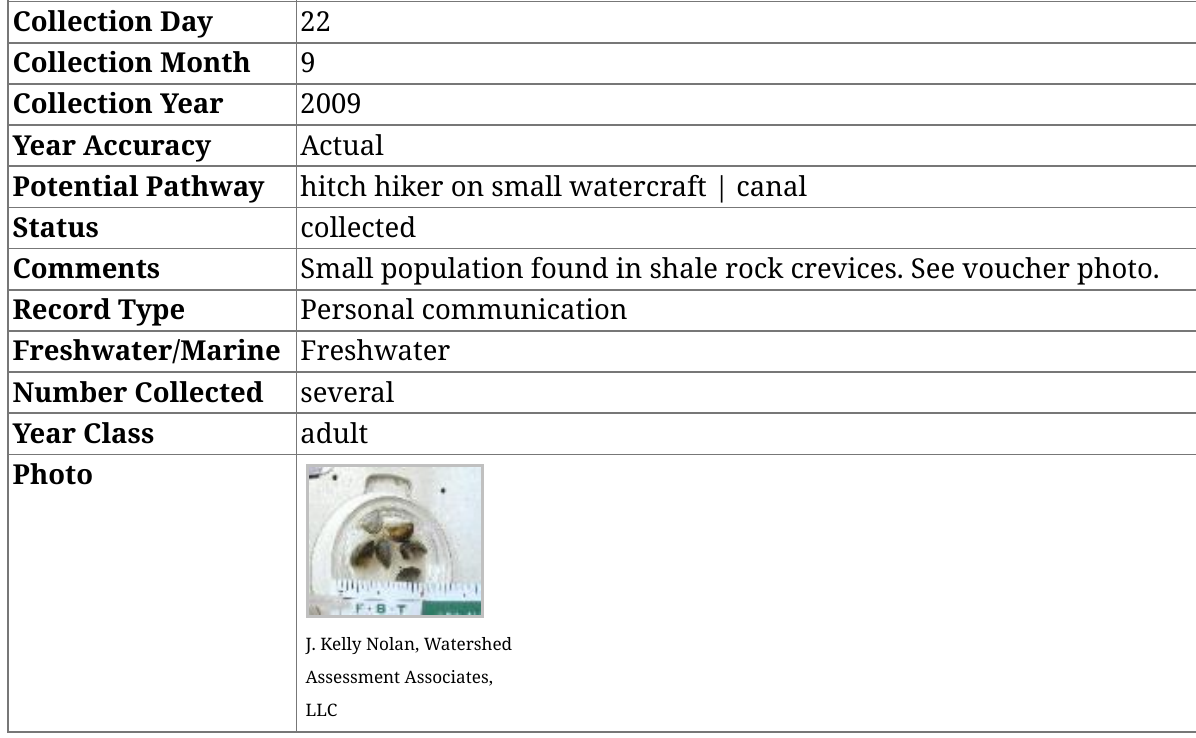
The shale crevices were not an abstract database phrase. That was the river edge where Chris looked down. That was the field description we reported.
By then, I no longer believed every record required me to become its public carrier. The work had narrowed. Find what is there. Preserve it. Report it. Let the record enter the system.
That was a change in me.
Years earlier, I had been more willing to fly the flag. I had worked with the Battenkill Conservancy, helped with River Watch, organized education and outreach, gave talks, brought students into streams, and put people in front of what the river was holding.
But by 2009, I was running a business. I was writing reports. I was providing data. I had already spent years as a nurse, then years dealing with agencies, workshops, students, presentations, and public environmental effort.
I could not keep carrying the flag.
We did what we were supposed to do. We reported the data.
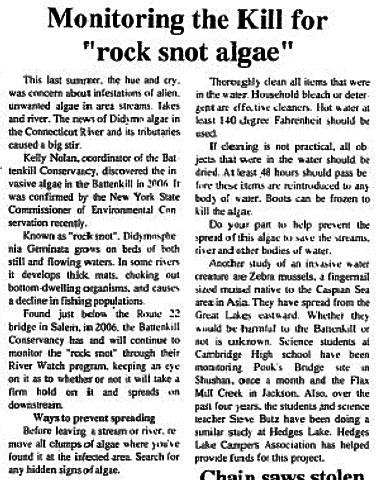
The Batten Kill had already carried other warnings. In 2006, Didymo had been found there. A 2007 local article named me as the Battenkill Conservancy coordinator who discovered the invasive algae in the Battenkill.
The same local article also held another thread. Steve Butz and Cambridge High School students had already been monitoring zebra mussels at Hedges Lake for several years. The later monthly monitoring at Pook’s Bridge in Shushan and Flax Mill Creek appears to follow the Batten Kill zebra mussel discovery.
That belongs here because it shows the find did not fall into an empty place. The watershed already had students, teachers, researchers, and local watchers looking for what might arrive.
Years before the Shushan record, I had taken Battenkill Conservancy students to the New York State Museum’s Cambridge Field Research Laboratory. One photograph from that visit still appears on the Conservancy site: students at microscopes while Dan Molloy stands beside them, teaching zebra mussel feeding habits. I took that photograph. Molloy is the tall man on the left.
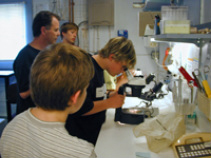
So when zebra mussels later turned up in exposed shale at Shushan, the find did not arrive as an abstract invasive-species record. It arrived inside a small professional world I already knew.
I had met Denise Mayer and Dan Molloy through that small professional world. I would not claim a close working relationship. Our paths crossed through conferences, outreach, and the Cambridge field station. Their work and my work touched the same watershed.
A year after the Shushan zebra mussel record, the New York State Museum announced a public talk: “Zebra Mussels and The Batten Kill: What’s the Threat?” The notice said the mussels had been discovered one year earlier in the Batten Kill, “a trout stream in Washington County,” and that residents and sportsmen feared the worst. I have not found the slides. I do not know what was said in the room. But the notice shows that the field report had traveled.
A mussel lifted from shale became a record.
A record became a public question.
The old biological-assessment language came back in another form.
A stream could be fit for survival but not propagation.
That had been the hard lesson behind other Batten Kill work. Survival and propagation are not the same claim. A reach can hold life without giving that life a future. A condition can allow presence without supporting renewal.
The zebra mussels raised that same distinction.
The geography was not neutral. Anyone who knew the watershed would have understood why the find at Shushan was uncomfortable. The Cambridge Field Research Laboratory was upstream in the same watershed landscape, and zebra mussel research was part of its work.
Questions followed naturally from that geography.
But questions are not evidence.
Evidence was what we had collected: several adult zebra mussels from shale crevices, preserved specimens, a photograph, and a report.
The adults proved presence.
They did not prove source.
They did not prove propagation.
The Batten Kill was fit for their survival.
Whether it was fit for their propagation was another question.
I could not answer more than the field had given me.
Chris looked down.
The shells were there.
We reported what we found.