
THE CHARRED LOG
Date / Moment: October 3, 2026
Location: Twin Ponds / fen
Type: OBSERVATION
Chris and I went out for a canoe paddle late Saturday morning, around 11:30, under a bluebird October sky. Temperatures were in the upper fifties and climbing toward sixty, with a light breeze out of the northeast.
We headed toward the narrows between Upper and Lower Twin and followed the western shore north, a direction we seldom take together. I had paddled portions of that shoreline southbound before and always enjoyed it. This time the shore gave us some shelter from the northeast breeze and a different view of a familiar part of the Ponds.
Despite the heavy maple defoliation earlier this year, the fall color along the shore was remarkably vibrant, particularly close to the water.
Near the northern corner of the fen we met the only other canoe we saw anywhere on Twin Ponds that day. The paddlers were residents of the western shore, and we floated together talking for a while before continuing on.
Rather than follow my usual route around the edge of the fen, I turned into the broad channel through its middle.
I had not paddled that way at all this year and probably not for well over a year, perhaps two. I have generally preferred following the margins of the fen rather than cutting through the center.
In places the opening was close to thirty yards wide, with fen on either side. I found myself wondering how much of that width represents the original cutting and how much developed afterward as the floating mat moved and changed.
When I am on these Ponds, I spend a lot of time looking down—at drowned timber, old stumps, the edge of the fen, changes in the bottom, and anything that stands apart from its surroundings.
While doing that, I noticed a large black log ahead of us.
It stood out enough that I turned the canoe toward it.
As we came closer, my first thought was:
Is that charred?
Yes. It was.
I estimated that at least three quarters of the exposed surface was charred, in places deeply. The remaining exposed areas were tan to gray and weathered.
From close by I could also get a better sense of its size. The timber was roughly the length of my thirteen-foot canoe and perhaps twenty to twenty-four inches in diameter. It lay horizontally, with perhaps three quarters submerged, and much of the wood below the surface carried a heavy coating of algae.
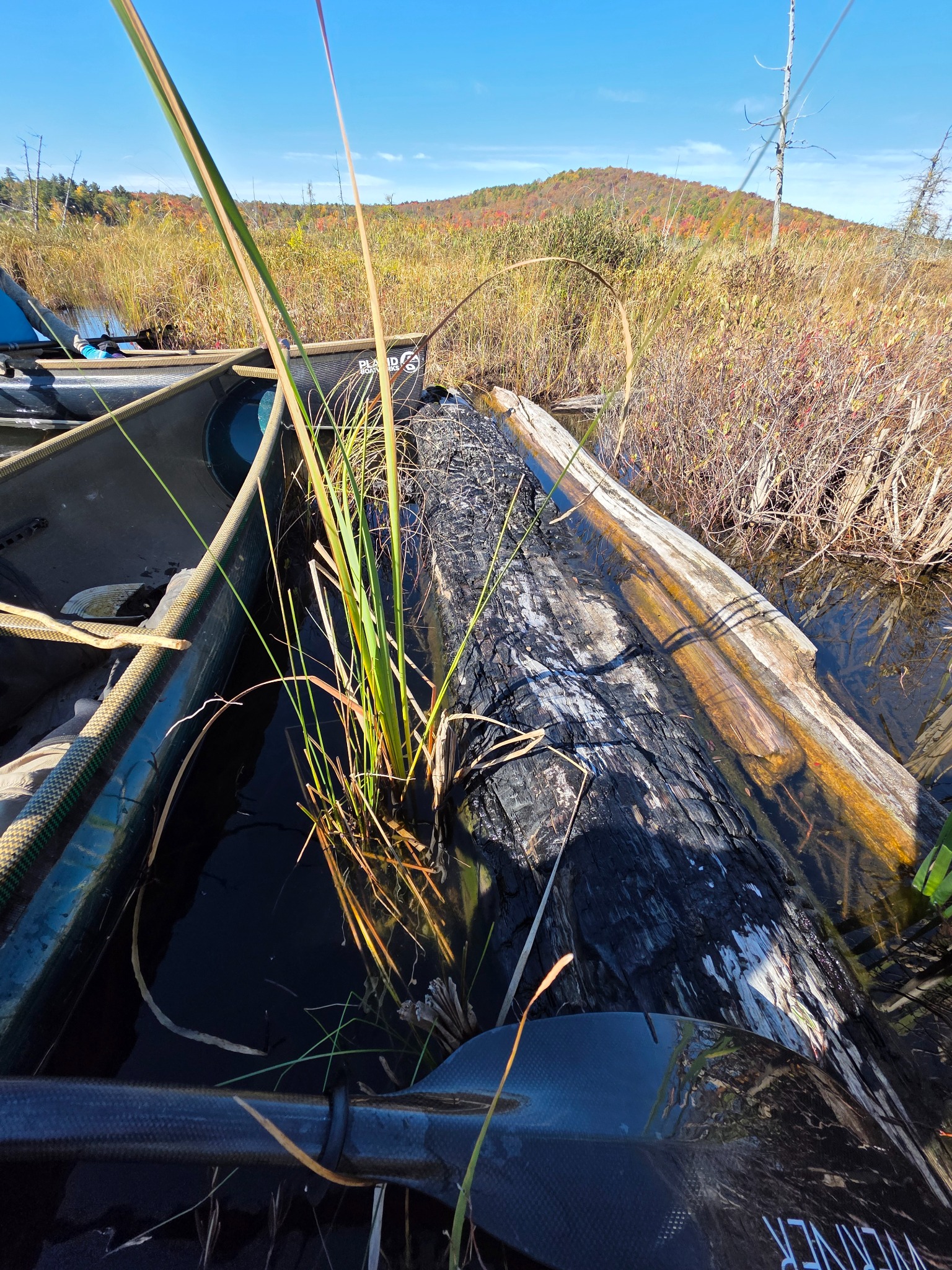
The ends caught my attention as well. Rather than ending square across the timber, the visible end surfaces ran diagonally. I could not tell from the canoe what had produced that form.
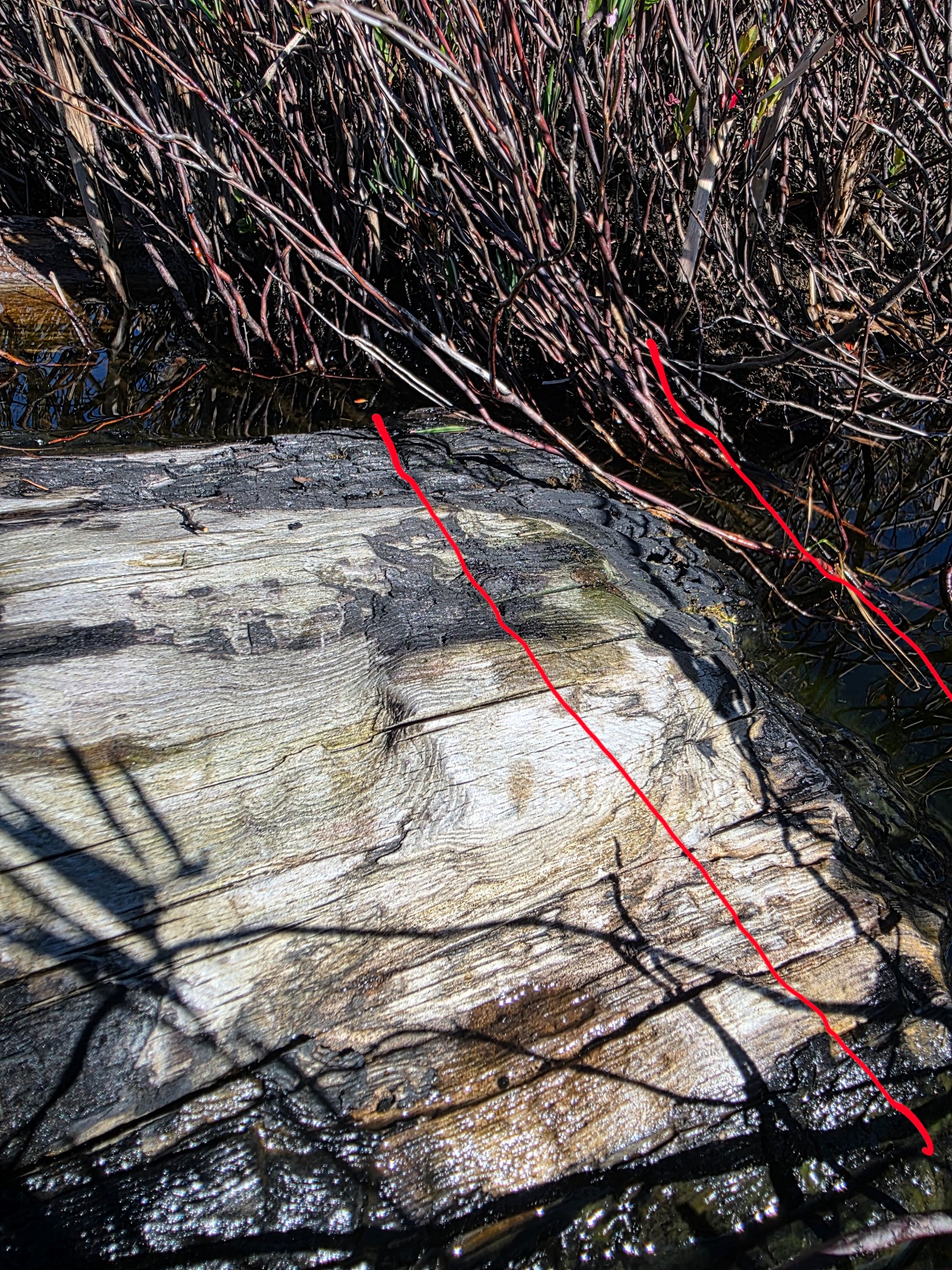
There were also worn depressions in the exposed wood. One in particular was smooth and shallow, rising gradually toward its edges. It reminded me of depressions worn into bedrock by stones moving in water, and also of the kind of hollow produced when one surface is repeatedly worked against another.
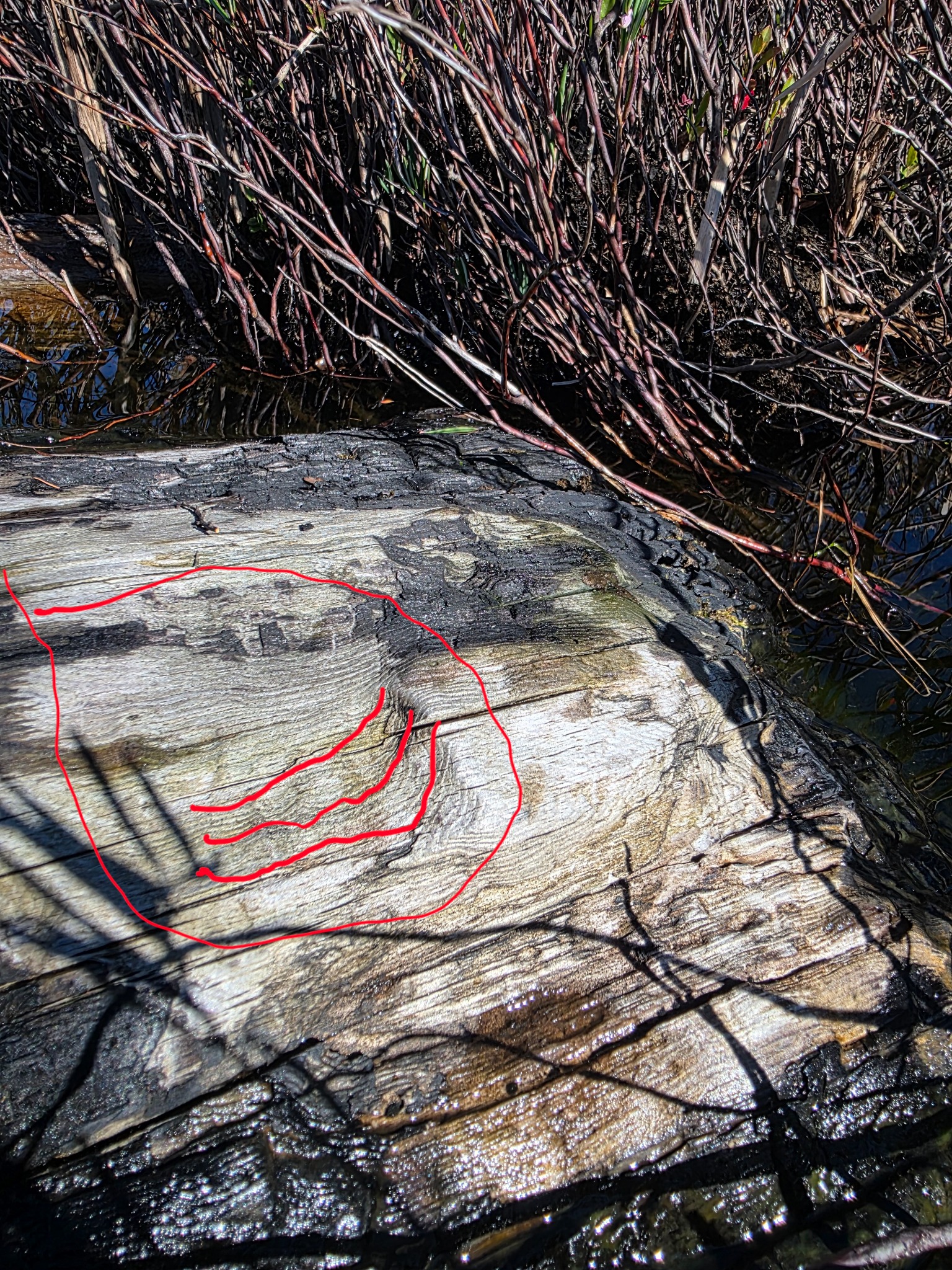
With the two dugouts already part of the history of this fen, it was impossible not to wonder about it.
I took several photographs from the canoe.
On the paddle back, Chris was interested too and asked what I was going to do. I told her I might come back and try to get better photographs, depending on the weather.
I also thought I would contact a professor at Paul Smith’s College. I had been meaning to contact him anyway about several other questions concerning the Ponds, and now I had one more.
For now, the log remains where I found it.
It is, at least for the moment, what I first thought it was when I paddled closer:
a large charred log.